What are we not seeing in the Universe?
This question can be answered in two ways - the first, what we literally cannot see, that is, the part of the Universe that is beyond the scope of our eyes. Second, the part of the Universe that we do not know about at all, even using all our senses and all the instruments at our disposal.
 Our eyes are sensors of electromagnetic radiation, that is, light. As Nature is very efficient, our eyes detect only the right amount of the Sun's light to protect ourselves from predators and find food. Unfortunately, this means that we do not see a lot of the light that is around, such as X-Rays, UV-rays, IR rays, Radio waves, Microwaves, etc. This image shows how much we don't see - the same object photographed in six different frequency ranges.
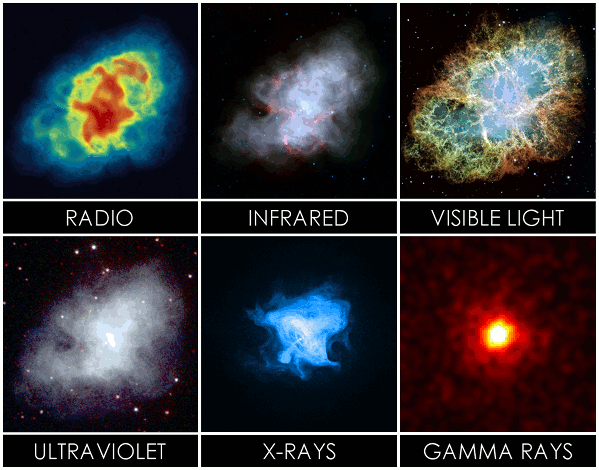 Our eyes are sensors of electromagnetic radiation, that is, light. As Nature is very efficient, our eyes detect only the right amount of the Sun's light to protect ourselves from predators and find food. Unfortunately, this means that we do not see a lot of the light that is around, such as X-Rays, UV-rays, IR rays, Radio waves, Microwaves, etc. This image shows how much we don't see - the same object photographed in six different frequency ranges.
Today there are telescopes that look at every part of the electromagnetic spectrum. However, there are not enough to look at every part of the sky, so quite a lot of the Universe remains unseen.
The part of the Universe that we know nothing about is comprised of "dark matter." We know nothing about dark matter, other than that it is made up particles that are unlike protons and neutrons (baryons.) Dark matter does not interact with light at all, making it impossible to detect with our current technical knowledge. However, many theoretical models show that galaxies have to contain more mass than what we can see in them. The predictions for the amount of dark matter in the Universe also vary, with some scientists saying that up to 80% of the matter/energy in the Universe is due to dark matter. As this is a completely theoretical concept, and there is no way to practically test for it, there are quite a few oppositions to this theory.


Comments
Post a Comment