What is the Hubble Telescope? Is it being used now?
The Hubble Space Telescope (HST) was launched in 1990 aboard the Space Shuttle Discovery. It was the beginning of a revolution in Astronomy, as it could see beyond the veil of the atmosphere. It was not the first space telescope - working telescopes have been used in space as early as 1968. However, Hubble was larger than the previous telescopes, and could capture visible light as well as near-infrared and near-ultraviolet frequencies.
The telescope has contributed vastly to human knowledge, not to mention photographs beyond human imagination. Here are some of the most spectacular:
The Hubble Extreme Deep Field

Light can travel only at the rate of 3 lakh kilometers per second. This implies that if an object is so far that it takes light a year to reach us, we will see it as it was a year back. This is an especially exciting concept in astronomy - telescopes actually show you the past, and the more powerful the telescope, the more you see into the past. The Hubble Extreme Deep Field photograph (2012)
was taken by pointing the Hubble Space Telescope at a direction in the sky which is relatively free of bright stars. The resulting image shows galaxies as they were 13.2 billion years back!
A comet crashes into Jupiter
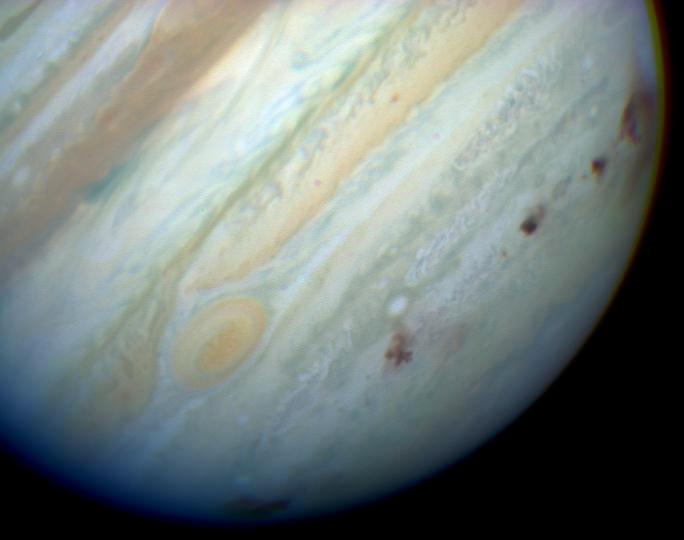
In 1992, the comet Shoemaker-Levy 9 crashed into Jupiter. Jupiter is hit by comets quite often (in Astronomical terms - once every few hundred years.) The collision was photographed in detail by the Hubble Space Telescope.

Hubble has also photographed the Moon and the planets as well as bodies in the asteroid belt. The intricate details of deep-sky objects (galaxies, star clusters, nebulae) have also been revealed by Hubble. One of the best examples is the photograph of the Orion Nebula. The picture showed disks of dust around approximately 200 stars. Some of the disks had planets forming in them.
This proved the theory of where planets come from - from disks of dust surrounding newly formed stars.
It is still in use, and is going strong. However, it has been in use for 27 years and a few months, and it will start slowly falling to Earth soon if it is not given a boost. There are servicing missions planned, or it may be de-orbited to Earth.
Here's a bit of history that eyeglass wearers would like - the first images from the Hubble Telescope were blurry, due to an error in the optics. A separate mission was carried out and corrective optics were installed, bringing the images to the superb clarity that we have today.


Comments
Post a Comment