Spin a top and leave it, and it stops after a while. Why does the Earth continue to rotate?
To answer this question, we have to see why the rotation started.
Most of the celestial bodies in the Solar System rotate in a counter-clockwise direction, when seen from directly above Earth's North Pole. This is because the Sun, the planets, their satellites, asteroids and other objects in the Solar System all formed out of a protoplanetary disk, which was moving in a counter-clockwise direction.
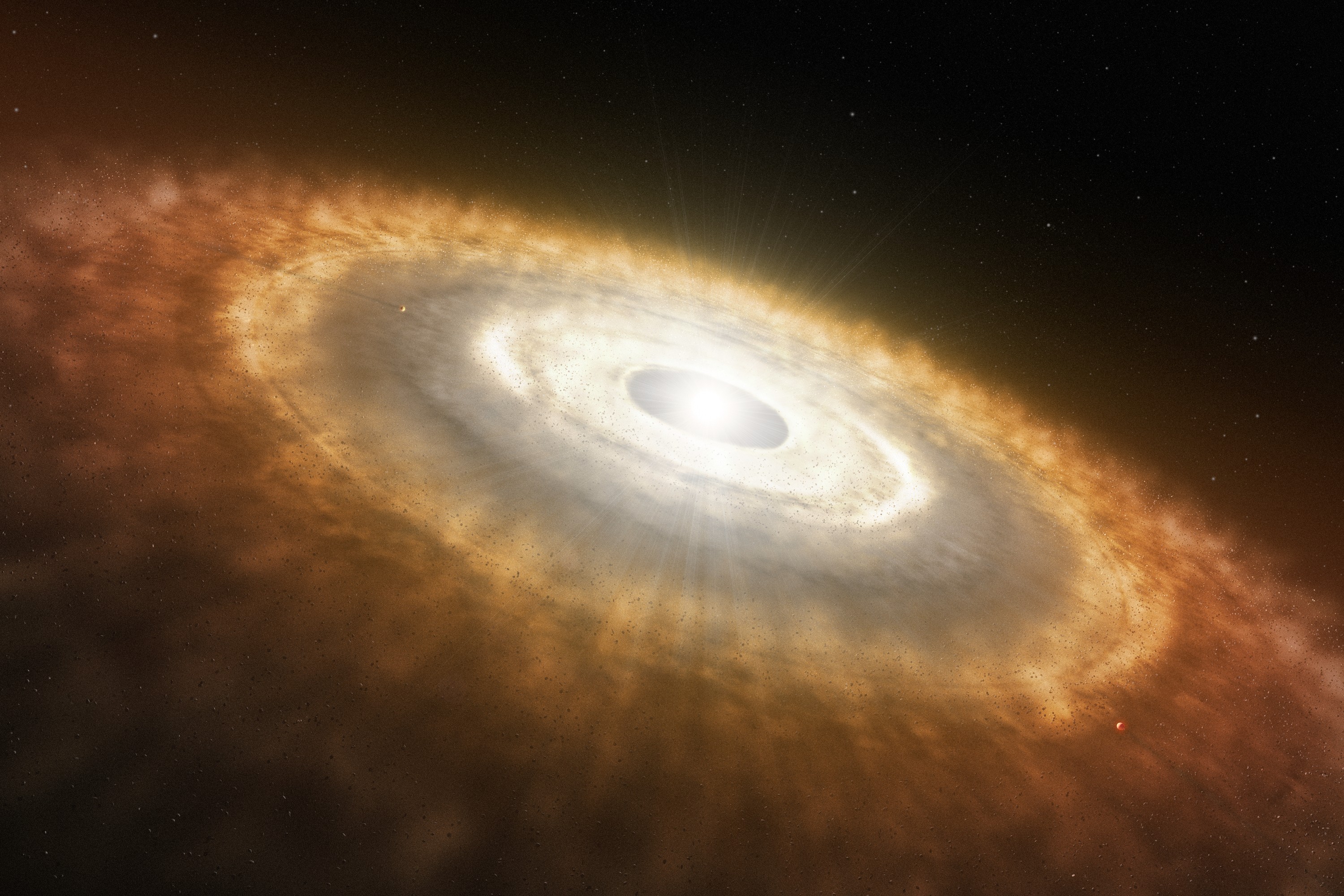 The protoplanetary disk was a huge amount of matter, thrown out by a star that existed before the Sun formed. It was not a uniform disk - mass was concentrated more in some parts than others, and these regions could exert gravitational attractions towards the material around them. The center of this disk, where the mass concentration was the most, formed the Sun, while around it, material collected into smaller bodies.
One of these was the Earth, which was at first a concentration of matter. The material around it was captured by the gravitational field of this mass, and began to orbit it. These orbits were in the counter clockwise direction since they were already moving that way, and then fell to the Earth. As a result, the Earth itself started moving in the counter-clockwise direction. So there was no outside force applied to make the Earth rotate, just the particles which make up the Earth itself.
The movement that started this way continues due to Inertia - there is nothing to slow down the rotation, like the air around a spinning top slows it down. However, the Earth is under another force, the gravitational pull of the Moon. This means that the Earth is slowing down at 1.7 milliseconds every 100 years


Comments
Post a Comment